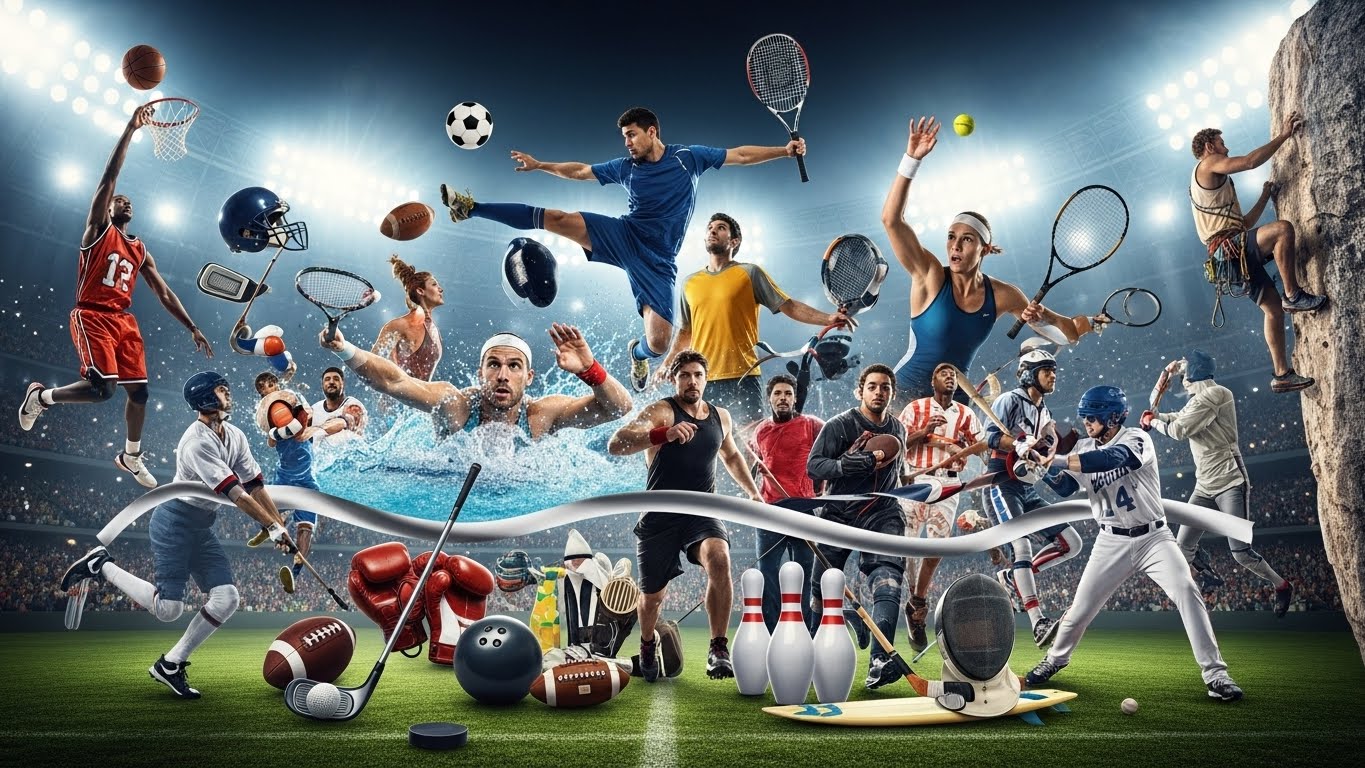







Sports have always been more than just games. They are a reflection of human spirit, passion, endurance, and unity. From the dusty arenas of ancient Greece to the glittering stadiums of the 21st century, sports have evolved into a global phenomenon that shapes cultures, economies, and even politics. In every era, sports have served as a stage for human excellence, where individuals and teams push beyond limits, driven by the desire for victory and recognition.
This blog dives deep into the vast world of sports — its rich history, societal influence, technological transformation, and the emotional magic that makes it such an inseparable part of human life.
A Journey Through Time: The Origins of Sports
The story of sports begins long before the modern world even existed. Archaeological evidence suggests that organized physical contests have been part of human civilization for thousands of years. Ancient Egyptians, Greeks, and Romans all had their own versions of athletic competitions. These were not merely recreational; they were deeply intertwined with religion, war preparation, and social order.
In ancient Greece, the Olympic Games emerged as a celebration of physical and spiritual excellence. The first recorded Olympics took place in 776 BCE in Olympia, where athletes competed in running, wrestling, and chariot racing. Victors were celebrated like heroes, their names etched into history. Similarly, in ancient China, sports such as archery, swordplay, and early forms of football known as “Cuju” flourished. For the Mayans and Aztecs of Central America, ball games held ritualistic significance, often linked to mythology and the gods.
Sports, in their earliest forms, were a mirror of human civilization — reflecting both its simplicity and complexity. They embodied the idea of striving for greatness, an idea that remains the soul of athletics even today.
The Renaissance of Physical Culture
The Middle Ages saw a decline in organized sports, largely due to social and political instability. Yet, the human desire for competition never truly faded. Knights jousted in tournaments, peasants played rough village games, and hunters engaged in archery contests.
With the dawn of the Renaissance, Europe witnessed a rebirth not only in art and science but also in physical culture. The rediscovery of classical ideals inspired scholars and nobles to embrace physical training as essential to education and health. Schools began incorporating games and exercises, setting the stage for modern sports education.
By the 18th and 19th centuries, industrialization changed the world, and with it, the nature of sports. The rise of cities, railways, and mass media helped standardize rules and spread games across continents. England, in particular, played a central role in formalizing sports like cricket, football (soccer), rugby, and tennis. These sports soon crossed oceans, creating international followings that would one day unite billions of fans.
The Birth of Modern Sports
The late 19th and early 20th centuries marked the birth of modern sports as we know them. This era saw the formation of organized clubs, governing bodies, and standardized rules. The modern Olympic Games, revived in 1896 by Pierre de Coubertin, became a global celebration of athletic excellence and international unity.
The concept of sportsmanship — fair play, respect, and integrity — gained importance, emphasizing character as much as skill. Sports evolved from local pastimes into organized spectacles, accessible to both participants and spectators. Football leagues in England, baseball in America, and hockey in Canada began to professionalize, turning athletes into celebrities and sports into a cultural force.
The modern age also introduced the power of sports to transcend barriers. Events like Jesse Owens’ triumph in the 1936 Berlin Olympics challenged racial ideologies, while the post-war Olympic Games served as symbols of peace and recovery. From the cricket fields of India to the basketball courts of the United States, sports became an expression of identity, pride, and unity.
The Rise of Global Icons and National Pride
The 20th century created sports legends whose fame transcended generations. Figures like Muhammad Ali, Pelé, Michael Jordan, Serena Williams, and Usain Bolt didn’t just win titles — they inspired billions. Their stories of perseverance, courage, and triumph became global narratives.
Muhammad Ali, beyond being a boxing champion, used his platform to stand for social justice and equality. Pelé brought beauty to football, turning it into the world’s most beloved sport. Michael Jordan redefined basketball, making it an art form, while Serena Williams broke barriers in tennis, proving that strength and grace can coexist. Usain Bolt, the “Lightning Bolt,” electrified the world with his unmatched speed and infectious charisma.
For nations, sports achievements became a source of pride and unity. When India won the Cricket World Cup in 1983, it ignited a national passion that still burns today. When South Africa won the Rugby World Cup in 1995, it became a symbol of post-apartheid unity. Sports could heal, inspire, and unite — even where politics and diplomacy failed.
The Power of Sports in Society
Beyond entertainment, sports have always had deep societal impact. They build communities, teach discipline, and create role models. They also offer a platform for important conversations on gender, race, and equality.
Women’s participation in sports, once restricted by social norms, has grown exponentially. Icons like Billie Jean King, Mia Hamm, and Simone Biles shattered stereotypes and redefined what women could achieve. Their victories extended beyond medals — they were victories for representation and progress.
Sports have also played a crucial role in youth development. Participation instills teamwork, resilience, and respect. It teaches how to win with humility and lose with grace. In many underprivileged regions, sports serve as a path to education and opportunity, offering hope where few other avenues exist.
At the same time, sports have become a reflection of global issues. The fight against racism, sexism, and discrimination continues, with athletes increasingly using their voices to advocate for change. From the Black Lives Matter movement to campaigns promoting inclusivity, sports remain a powerful medium for social transformation.
Technology and the New Age of Sports
The 21st century has ushered in a technological revolution in sports. From performance analytics to wearable devices, data has become as important as training. Coaches can now measure every heartbeat, stride, and reaction time to optimize performance. Artificial intelligence and biomechanics are helping athletes reach previously unimaginable levels of precision and endurance.
Instant replay, VAR (Video Assistant Referee), and goal-line technology have transformed officiating, reducing human error and ensuring fairness. Drones and advanced cameras capture every moment from breathtaking angles, making viewing experiences more immersive.
Even fan engagement has changed dramatically. Social media platforms have given athletes direct access to millions of supporters, breaking the barrier between stars and spectators. Esports, once dismissed as a niche interest, has become a global powerhouse, blurring the line between gaming and traditional competition.
In this new era, sports are not confined to physical boundaries. Virtual reality allows fans to experience stadiums from their living rooms. Fantasy leagues and digital sports management games have created entire ecosystems of virtual competition. The world of sports has entered an age where data meets emotion, and the possibilities are endless.
Economics of Sports: The Business Behind the Game
Sports today are not just about competition; they are a colossal industry that fuels global economies. Major events like the Olympics, FIFA World Cup, and Super Bowl generate billions in revenue through sponsorships, broadcasting rights, and merchandise.
Clubs and franchises operate like multinational corporations. Teams such as Real Madrid, Manchester United, and the New York Yankees command immense global fanbases, driving apparel sales and media deals that shape entire markets. Sports branding has become an art in itself, turning athletes into walking enterprises.
Endorsements, advertisements, and social media presence have given rise to the concept of the “athlete influencer.” Stars like Cristiano Ronaldo and LeBron James earn more off the field than on it, showing how fame and business have become deeply intertwined.
However, the commercialization of sports has also raised ethical debates. Issues like exploitation, over-commercialization, and the pressure of constant performance weigh heavily on athletes. Balancing profit and passion remains one of the great challenges of the modern sports industry.
The Emotional Power of Sports
What truly makes sports magical is its emotional connection. The feeling of anticipation before a big match, the roar of a crowd, the heartbreak of defeat, and the ecstasy of victory — these moments define the human experience. Sports unite people across cultures, languages, and borders in a way few things can.
When a team wins, entire nations celebrate. When an underdog triumphs, the world watches in awe. The beauty of sports lies in its unpredictability — the idea that on any given day, anything can happen. It’s this uncertainty that fuels passion, makes fans loyal, and turns moments into memories.
For fans, sports provide escape, joy, and belonging. For athletes, they are a test of willpower, discipline, and character. Every game is a story — one of struggle, sacrifice, and triumph. Sports remind us that failure is not the end but a step toward greatness, that teamwork matters, and that resilience can overcome even the toughest challenges.
Sports and the Media Revolution
Media has always been the heartbeat of sports popularity. In the early days, radio broadcasts brought games to living rooms, making fans feel part of the action. Television then transformed the experience, turning athletes into household names.
Today, digital media has taken it to another level. Fans don’t just watch — they participate. They analyze plays, follow training routines, comment live, and even influence club decisions through fan voting systems. Streaming platforms have made sports accessible anytime, anywhere, democratizing viewership across the world.
Documentaries and behind-the-scenes content now give fans an intimate look into the lives of their heroes, humanizing them and deepening emotional connection. Sports journalism, podcasts, and fan-led content have expanded the conversation far beyond the field.
Challenges in the Modern Sports World
Despite its beauty and influence, sports face significant challenges. Doping scandals, corruption in governing bodies, match-fixing, and financial disparities threaten the integrity of competition. The mental health of athletes, long overlooked, has become a pressing concern. The constant pressure to perform and the scrutiny of media can take a heavy toll.
Moreover, inequality in funding between men’s and women’s sports persists, despite growing awareness and advocacy. Access to facilities, coaching, and sponsorships remains limited in many regions. Environmental sustainability has also become an issue, as mega-events often leave massive carbon footprints.
Addressing these challenges requires global cooperation and ethical reform. Sports must continue to evolve — not just technologically, but morally — ensuring fairness, inclusivity, and respect for both people and the planet.
The Future of Sports: Innovation and Inclusion
The future of sports promises even greater transformation. Artificial intelligence, virtual reality, and biotechnology will redefine training, performance, and recovery. Smart stadiums powered by renewable energy will offer immersive fan experiences with minimal environmental impact.
Inclusivity will be at the heart of this evolution. Paralympic sports have already proven that ability is not limited by physical condition. Adaptive technology will further break barriers, allowing more people to compete and enjoy the benefits of sports.
Youth development programs will continue to expand, using sports as a vehicle for education and empowerment. Grassroots initiatives across the globe will nurture talent from the streets to the world stage, ensuring that passion and potential — not privilege — determine opportunity.
Conclusion: The Timeless Magic of Sports
Sports are more than contests; they are celebrations of humanity. They embody the courage to dream, the discipline to train, and the resilience to overcome. Whether it’s a child chasing a ball in a village or a professional competing in front of millions, the essence remains the same — a pursuit of excellence and joy.
In every cheering crowd, every teardrop after defeat, and every handshake between rivals, sports remind us of our shared humanity. They show us that while we may differ in culture, language, or belief, we all understand the thrill of competition and the beauty of striving for something greater than ourselves.
The story of sports is, ultimately, the story of us — of what it means to be human. From ancient arenas to digital stadiums, from stone balls to smart sensors, the spirit of sports continues to evolve, inspiring generations to dream, to play, and to believe.